Uneven Anomie
This essay examines why anomic conditions emerge unevenly across institutions, comparing domains where disagreement still culminates in closure with those where evaluation persists without verdict.
Abstract
This essay examines the uneven distribution of anomic conditions across contemporary institutions. Rather than treating non-settlement as a universal feature of modern life, it asks why some domains continue to reach closure under disagreement while others do not. Building on a diagnostic account of anomie as the erosion of authorized decision, the essay compares institutional settings in which disputes terminate—imperfectly but decisively—with those in which evaluation persists without verdict.
Through a series of contrast cases, including elections, courts, medicine, and organizational and platform-based systems, the essay identifies the structural conditions that preserve or undermine closure. It argues that anomie emerges not from disagreement, pluralism, or moral decay, but from the diffusion of authority, the expansion of interpretability, and the absence of procedures empowered to bind outcomes despite contestation. The contribution is comparative and analytic rather than prescriptive: to specify anomie as a patterned failure mode, unevenly distributed across domains, and to clarify the institutional features that continue to make settlement possible.
Methodological Preface
This essay adopts a comparative, institution-centered approach. Its aim is not to evaluate the moral legitimacy of particular outcomes, nor to assess the fairness of the institutions discussed, but to examine how they function as mechanisms of closure. The analysis proceeds by contrasting domains in which disagreement is routinely terminated through authorized procedures with those in which evaluation remains open-ended. No claim is made that closure is ever complete, just, or uncontested; only that it occurs with sufficient regularity to permit coordination. By focusing on institutional design rather than actor intention or cultural belief, the essay treats anomie as a structural condition whose presence and intensity vary across settings. It offers no solutions and advances no program of reform, confining itself to diagnostic comparison and the identification of boundary conditions under which settlement remains possible.
I. Why Variation Matters
Diagnoses of anomie often fail by excess. When breakdown is treated as total, explanation slides into lament, and structural analysis gives way to generalized unease. This essay proceeds from a narrower and more defensible premise: anomie is not a uniform condition of modern life, but a patterned failure that appears unevenly across domains. The task, therefore, is not to decide whether contemporary institutions are legitimate or humane, but to ask where and under what conditions settlement still occurs.
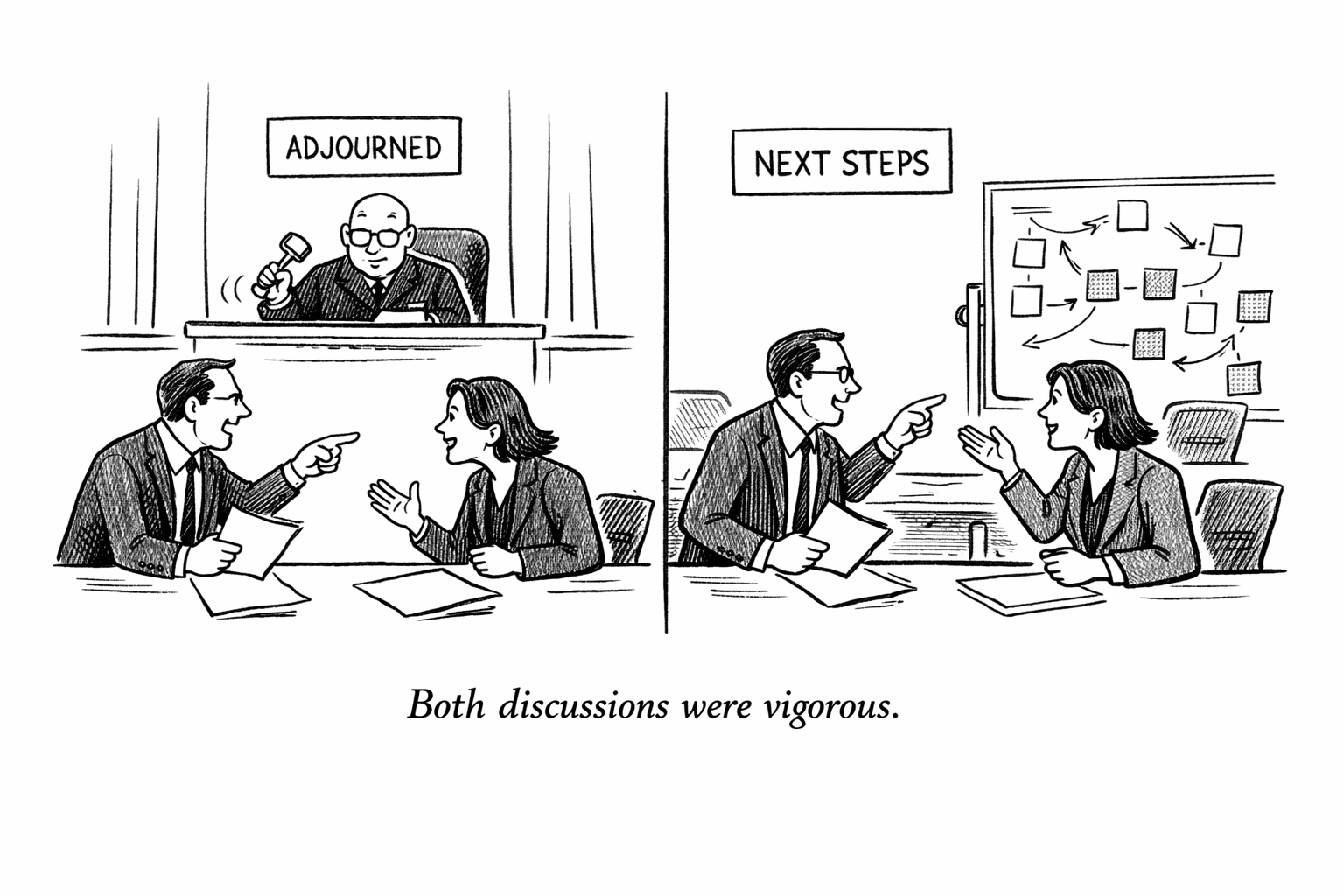
Variation matters because disagreement alone does not produce anomie. Many institutions are built precisely to operate under persistent disagreement. What distinguishes anomic settings is not the intensity of contestation, but the absence of any actor or procedure empowered to terminate it. Where decision remains authorized, disputes can end without consensus. Where authorization diffuses, evaluation persists without verdict.
Treating anomie as uneven allows several analytic gains. It prevents the diagnosis from collapsing into a civilizational claim. It makes visible the structural features that preserve closure in some settings while eroding it in others. And it permits comparison without nostalgia: institutions that still bind outcomes need not be fair, efficient, or morally admirable to function as mechanisms of settlement.
The comparative approach adopted here therefore asks a limited set of questions. In which domains does disagreement routinely culminate in binding outcomes? What institutional features make that termination possible? And where closure has weakened, what structural changes account for its erosion? By answering these questions, the analysis aims not to rehabilitate particular institutions, but to clarify the boundary conditions under which coordination remains possible despite enduring conflict.
II. Domains Where Closure Has Weakened Most
The uneven distribution of anomic conditions becomes visible when attention shifts from abstract claims to institutional operation. Certain domains repeatedly exhibit a distinctive pattern: participation continues, evaluation intensifies, and yet outcomes fail to settle. In these settings, disagreement is not resolved, but neither is it decisively ended. What persists is a state of prolonged assessment without authorized termination.
One such domain is platform-mediated interaction. Content moderation, participation norms, and reputational standing are subject to continuous review, appeal, and reinterpretation. Decisions are often framed as provisional, reversible, or subject to future correction. Authority is distributed across algorithms, committees, and user feedback mechanisms, none of which is empowered to bind conclusively. As a result, visibility increases while finality recedes. Participation remains possible, but closure becomes structurally unavailable.
A similar pattern appears in contemporary knowledge work. Evaluation through peer review, performance metrics, and feedback systems is no longer confined to discrete stages. Assessment accompanies production continuously, and judgments are rarely final. Work remains perpetually revisable, careers perpetually evaluable. Here again, the problem is not disagreement about quality or merit, but the absence of any moment at which evaluation is authorized to stop. Recognition circulates, but authority does not consolidate.
Organizational life increasingly exhibits the same dynamics. Projects expand without clear endpoints; responsibilities diffuse across teams and stakeholders; accountability is distributed without discharge. Decisions are deferred in the name of inclusivity, risk mitigation, or flexibility. While such practices are often adopted to avoid error or exclusion, their cumulative effect is to erode the capacity to conclude. Action proceeds, but settlement does not.
Finally, intimate and relational domains show analogous forms of non-settlement. Entry is easy, participation fluid, and exit ambiguous. Roles and expectations are negotiated continuously rather than fixed through shared conventions. Disagreement is managed through ongoing communication rather than decisive rupture. In the absence of recognized moments of conclusion, relationships may persist in attenuated form long after their substantive basis has dissolved.
Across these domains, the common feature is not moral decline or intensified conflict. It is the structural inability to terminate evaluation despite continued engagement. Authority diffuses, decisions remain revisable, and time ceases to function as a mechanism of closure. These are the settings in which anomic conditions are most pronounced—not because disagreement is greater, but because settlement has become institutionally illegible.
III. Domains Where Closure Still Holds (Partially)
If anomie is unevenly distributed, then some institutional settings must still demonstrate the capacity to terminate disagreement. These settings do not eliminate conflict, nor do they secure consensus. What they preserve is more modest and more consequential: procedures authorized to decide, even when outcomes are contested. Closure in these domains is therefore partial, imperfect, and often criticized—but it occurs.
Elections provide a clear illustration. They are designed explicitly to operate under disagreement and to conclude it at a specified moment. Competing claims are expressed, aggregated, and counted according to authorized procedures, and the result binds subsequent action regardless of residual dissent. The legitimacy of elections does not rest on unanimity, nor on the moral agreement of participants, but on the recognized authority of the procedure to end contestation at a defined time.
Courts function similarly. Legal disputes routinely involve incompatible interpretations of fact and law, yet adjudication culminates in verdicts that bind parties and allocate responsibility. Appeals and revisions exist, but they are themselves procedurally bounded. What matters for settlement is not that decisions are immune to criticism, but that they are empowered to conclude disputes and authorize consequences despite disagreement.
Medical practice offers another contrast case. Diagnosis and treatment proceed under uncertainty and professional disagreement, yet care is organized around discrete phases with recognized endpoints. Patients are admitted, treated, and discharged; responsibility transfers; cases close. Errors and disputes occur, but the institutional structure preserves the authority to move from one phase to the next, allowing time to function as a mechanism of closure rather than indefinite evaluation.
Across these domains, closure depends on a common set of features: clearly authorized decision-makers, time-bounded procedures, and outcomes that are treated as binding even when imperfect. These features do not guarantee justice, accuracy, or satisfaction. They do, however, permit coordination by transforming disagreement into settled action.
The contrast with anomic domains is therefore not moral but structural. Where authorized procedures remain intact, disagreement does not metastasize into perpetual evaluation. Where such procedures erode, contestation persists without end. The presence or absence of closure is thus not a matter of intensity of conflict, but of institutional capacity to decide.
IV. Structural Conditions That Preserve Closure
The contrast between domains where settlement weakens and those where it persists points to a limited set of structural conditions that preserve closure. These conditions do not eliminate disagreement, error, or contestation. Rather, they enable institutions to transform ongoing conflict into settled action often enough for coordination to continue. Closure, in this sense, is not an ethical achievement but an operational one.
First, closure depends on the presence of clearly authorized decision-makers or procedures. In domains where it remains possible to say who is empowered to decide, disputes can terminate without consensus. Authority here is not charisma or expertise alone, but formal recognition that a particular actor or process may bind outcomes despite disagreement. Where such authorization diffuses or becomes ambiguous, decisions lose their capacity to conclude.
Second, closure requires time-bounded processes. Elections end on a specified date; trials conclude after judgment; courses of treatment move from diagnosis to discharge. Temporal boundaries do not guarantee good outcomes, but they establish phases that cannot be endlessly reopened. When processes lack recognized endpoints, evaluation expands to fill available time, and responsibility becomes continuous rather than episodic.
Third, closure depends on irreversibility. Decisions that can be endlessly revised, appealed, or optimized lose their binding force. In functioning settlement regimes, revision is possible but constrained: appeals have deadlines, retrials are limited, and reversals carry cost. Irreversibility need not be absolute, but it must be sufficient to prevent perpetual deferral.
Fourth, closure is supported by ratified exit. Participants must be able to leave roles, cases, or relationships in ways that are institutionally recognized as final. Discharge in medicine, acquittal or sentencing in law, and concession in elections all perform this function. Where exit is informal, ambiguous, or morally suspect, responsibility lingers and closure erodes.
Finally, closure requires limits on interpretation. In domains that preserve settlement, not every action remains open to infinite reinterpretation. Decisions fix meanings provisionally and restrict the range of subsequent readings. Where interpretation is unconstrained, outcomes remain perpetually contestable, and authority cannot consolidate.
Taken together, these conditions clarify why anomie appears unevenly rather than universally. Closure persists where authority is authorized, time is bounded, decisions carry irreversibility, exit is ratified, and interpretation is constrained. Where these features erode, disagreement no longer culminates, and institutions lose the capacity to bind. The problem, once again, is not conflict itself, but the structural weakening of the mechanisms that once brought it to an end.
V. What This Means for Anomics
The comparative analysis offered here clarifies the scope and limits of Anomics as a diagnostic framework. Anomie, as used throughout this project, does not describe a universal condition of modern life, nor a generalized moral decline. It names a patterned failure of settlement that appears under identifiable structural conditions and recedes where mechanisms of closure remain intact.
Seen in this light, Anomics is best understood as an account of institutional capacity rather than social mood. The question it poses is not whether disagreement has intensified, but whether institutions retain the authority to conclude disputes and discharge responsibility despite disagreement. Where authorized decision persists, conflict can be bounded and coordination sustained. Where authorization diffuses, evaluation continues without verdict, and participants are left to manage closure privately.
This perspective also reframes the relationship between modern complexity and institutional failure. Scale, pluralism, and technical sophistication do not by themselves produce anomie. They become destabilizing only when coupled with the erosion of time-bounded procedures, irreversible decisions, and ratified exit. Anomics therefore does not oppose complexity; it identifies the conditions under which complexity overwhelms settlement.
The implication for the broader project is a narrowing rather than an expansion of claims. Anomics does not argue that contemporary institutions should return to earlier forms, nor that closure is inherently just or humane. It argues that without some capacity to bind outcomes, institutions lose their coordinating function regardless of intent. Where closure fails, moral language intensifies, participation persists, and responsibility becomes continuous.
This essay stops at that clarification. Its purpose has been to show that anomie is unevenly distributed, structurally produced, and analytically separable from disagreement itself. By identifying where closure still holds and why, the analysis delineates the boundary conditions of Anomics without prescribing their restoration. Diagnosis, here, remains distinct from remedy—and that distinction is itself a form of closure.