Anomics as Negative Design Science
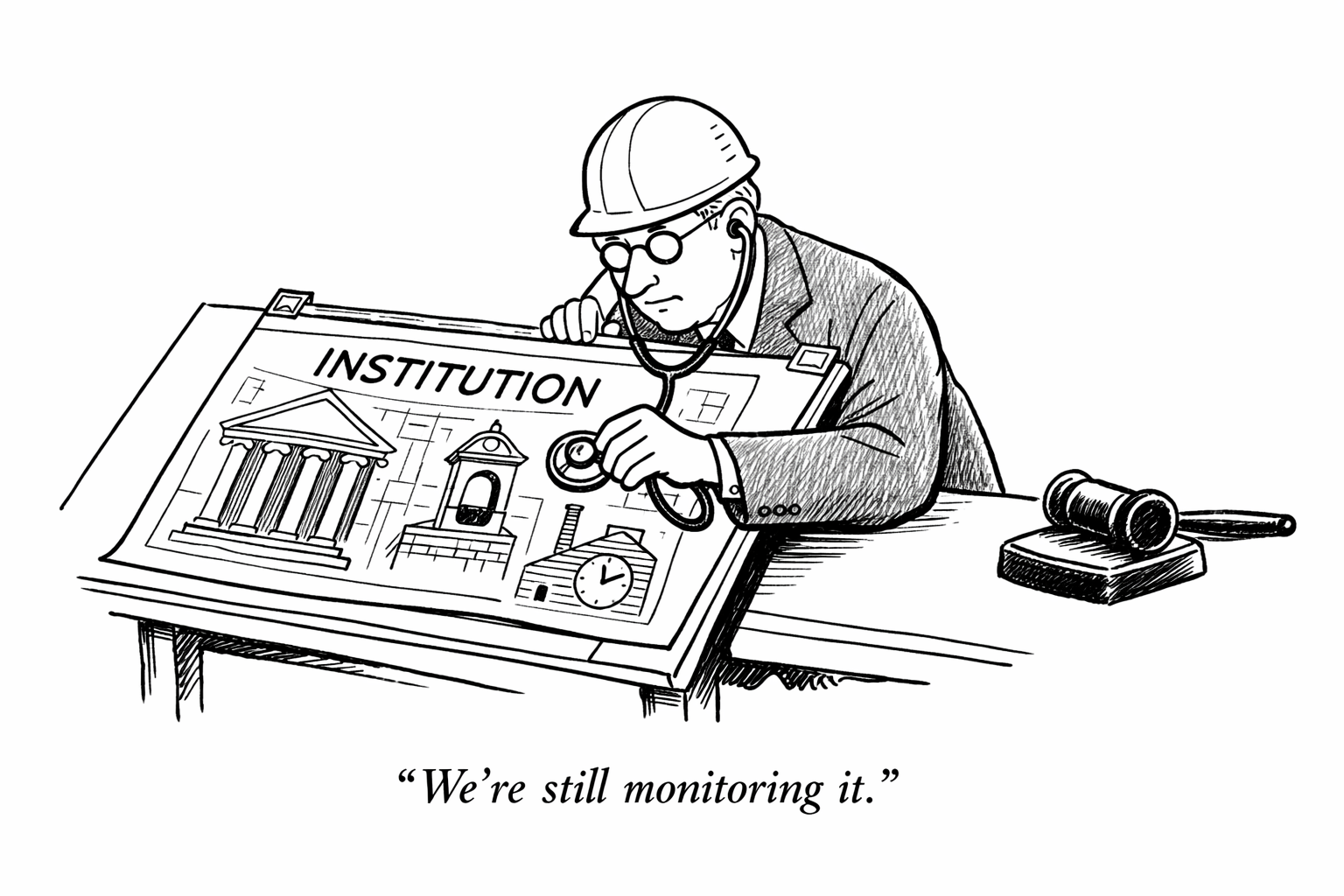
This essay frames Anomics as a negative design science, explaining how tools optimized for continuous adjustment produce anomie when applied to institutions that must impose closure.
Binding Failure in an Age of Continuous Adjustment
Abstract
Contemporary diagnoses of anomie often frame it as a loss of shared meaning, moral consensus, or normative clarity. This essay advances a different account. It treats anomie not as a cultural or existential deficit, but as a systems failure produced by the misapplication of tools optimized for continuous adjustment to institutions that exist to impose closure. Drawing on insights from sociology, systems engineering, and finance, the essay argues that techniques designed to manage uncertainty without settlement—such as continuous feedback, reversibility, and optionality—have migrated beyond their original domains into social and institutional settings that require binding decisions to function. The result is not normlessness, but the weakening of settlement: disputes persist without verdict, obligations do not culminate, and responsibility diffuses across time. The essay formalizes Anomics as a negative design science—an analytic discipline concerned not with prescribing solutions, but with specifying the structural conditions under which coordination becomes impossible regardless of intention or goodwill.
Author’s Note
This essay is part of a broader project concerned with binding and settlement in modern institutions. It does not offer policy recommendations or moral prescriptions. Its aim is diagnostic: to clarify how certain forms of coordination failure arise, why they persist despite sincerity and effort, and what structural constraints they reveal.
Introduction: Anomie Without Loss
Anomie is commonly described as a loss: a loss of shared values, moral consensus, or meaning itself. In this view, modern life becomes disorienting because norms no longer tell us who we are or what we owe one another. The resulting prescriptions are familiar—restore community, strengthen values, improve communication, cultivate sincerity.
Anomics begins elsewhere. It treats anomie not as a loss of meaning, but as a failure of systems. More precisely, it understands contemporary anomie as the outcome of a persistent tool–domain mismatch: tools optimized for continuous adjustment have been generalized into institutional domains that exist to end things. What fails under these conditions is not meaning, but the capacity of meaning to bind across time.
This distinction is decisive. Meaning can proliferate without coordination. Norms can remain visible, frequently invoked, and sincerely expressed while losing their capacity to constrain conduct across time. The hallmark of an anomic environment is not silence or moral vacancy, but saturation—of explanations, intentions, values, and assurances. What disappears is settlement: the ability of a system to say that something counts, that something is finished, that responsibility has been allocated and discharged.
Continuous Adjustment as a Design Achievement
The tools now overextended across social and institutional life were not mistakes. They were among the most successful engineering achievements of the twentieth century. Continuous monitoring, feedback loops, dynamic optimization, risk hedging, and optionality preservation emerged to address real problems in domains defined by volatility and uncertainty.
Their success rests on a shared orientation. Continuous-adjustment systems are designed to minimize the cost of error by avoiding finality. States are reversible. Positions are revisable. Exposure can be redistributed in real time. Error is managed through ongoing correction rather than decisive judgment. Time is treated as a variable to be optimized, not as an authority that closes accounts.
Within their native domains—finance, logistics, control systems—these tools are stabilizing. They permit action without settlement, engagement without commitment, and participation without ownership. Their effectiveness invited imitation.
Institutions That Must End Things
The difficulty arises when this logic migrates into domains with fundamentally different functional requirements. Many social institutions exist not to manage continuous exposure, but to impose closure. Courts, regulatory bodies, schools, organizations, professional systems, and even intimate arrangements must allocate responsibility, terminate disputes, and render outcomes sufficiently legible for coordination to persist.
These are settlement institutions. Their defining function is not optimization, but finality. They must decide despite disagreement, bind despite uncertainty, and end processes even when outcomes are imperfect. Error is not eliminated; it is accepted as the cost of coordination.
When tools optimized for continuous adjustment are applied to such institutions, they do not fail dramatically. They succeed quietly. Decisions become provisional. Obligations remain negotiable. Authority diffuses. Reversibility expands. Participation intensifies while outcomes drift.
The system appears humane, flexible, and responsive. What it loses is the capacity to conclude.
Anomie as Binding Failure
Seen from this perspective, anomie is not primarily a crisis of belief or value. It is a failure of binding. Norms persist, but they no longer constrain future interpretation. Commitments are expressed, but they are not allowed to survive time. Speech proliferates, but it does not close action.
Individuals are forced to manage settlement privately—through vigilance, interpretation, and strategic restraint. This produces the characteristic affect of late modern life: not despair, but fatigue; not moral outrage, but exhaustion. The burden of coordination has not disappeared; it has migrated from structure to cognition.
Crucially, this condition does not require bad actors, moral decay, or cultural nihilism. It emerges from systems designed to minimize harm, error, and exclusion by avoiding finality. The resulting failure is structural, not ethical.
Anomics as Negative Design Science
What, then, is Anomics?
It is not a moral philosophy. It does not prescribe values. It does not advocate a return to tradition or a rejection of modern tools. Nor is it a humanist appeal to irreducible subjectivity. Anomics does not argue that humans cannot be modeled or that systems must be kinder.
Instead, Anomics can be formalized as a negative design science.
A negative design science does not propose optimal designs; it specifies impossibility conditions—the structural constraints under which systems cannot perform certain functions, regardless of intention or sophistication. It identifies failure modes produced not by poor execution, but by structural incompatibility.
In this case, the incompatibility is clear. Systems that must bind cannot function when designed primarily for continuous adjustment. Institutions that exist to end things cannot rely on tools that systematically defer endings. No amount of goodwill, transparency, or communication can compensate for this mismatch.
Anomics names this limit. It clarifies where binding is required, what costs it imposes, and why attempts to engineer those costs away produce anomie rather than freedom.
Conclusion: What Anomics Enables—and What It Refuses
As a negative design science, Anomics does not promise repair. It does not guarantee better outcomes. It does not resolve political or moral disagreement. What it offers is diagnostic clarity.
It allows institutions and individuals to recognize when failure is not a matter of effort, empathy, or optimization, but of structural impossibility. It explains why systems can remain active while becoming unreliable, expressive while incoherent, humane in intent while extractive in consequence.
Most importantly, it prevents wasted effort. It shows when more communication will not help, when flexibility undermines authority, and when continuous responsiveness erodes trust.
Anomics does not restore meaning.
It explains why meaning alone cannot bind.
And in doing so, it marks a boundary modern life has repeatedly crossed without noticing: the boundary between tools that manage uncertainty and institutions that must, at some point, decide.